

Your data provider has a performance score. You can simply ask to see it.
Imagine that next month, the company managing your product data is no longer allowed to do anything for six months. No more new products sent to your retailers. No updates made to a label that has just changed. Right in the middle of your season.
This is not a worst-case scenario we made up to scare you. It is a rule. It exists, and it is enforced. Most suppliers simply do not know about it — so they never ask about it either.
How the monitoring works
GS1 is the organisation behind the standard used by virtually the entire food supply chain. Every barcode on every shelf originates from that system, as do the rules governing which product information needs to be recorded where. Your retailers obtain their product data from that system.
GS1 Netherlands appoints companies that are authorised to capture and check this data on behalf of suppliers. Companies with such an appointment are reviewed roughly every month: GS1 takes a sample of the work that has actually been delivered and checks it. Not the report about the work. The work itself, data point by data point.
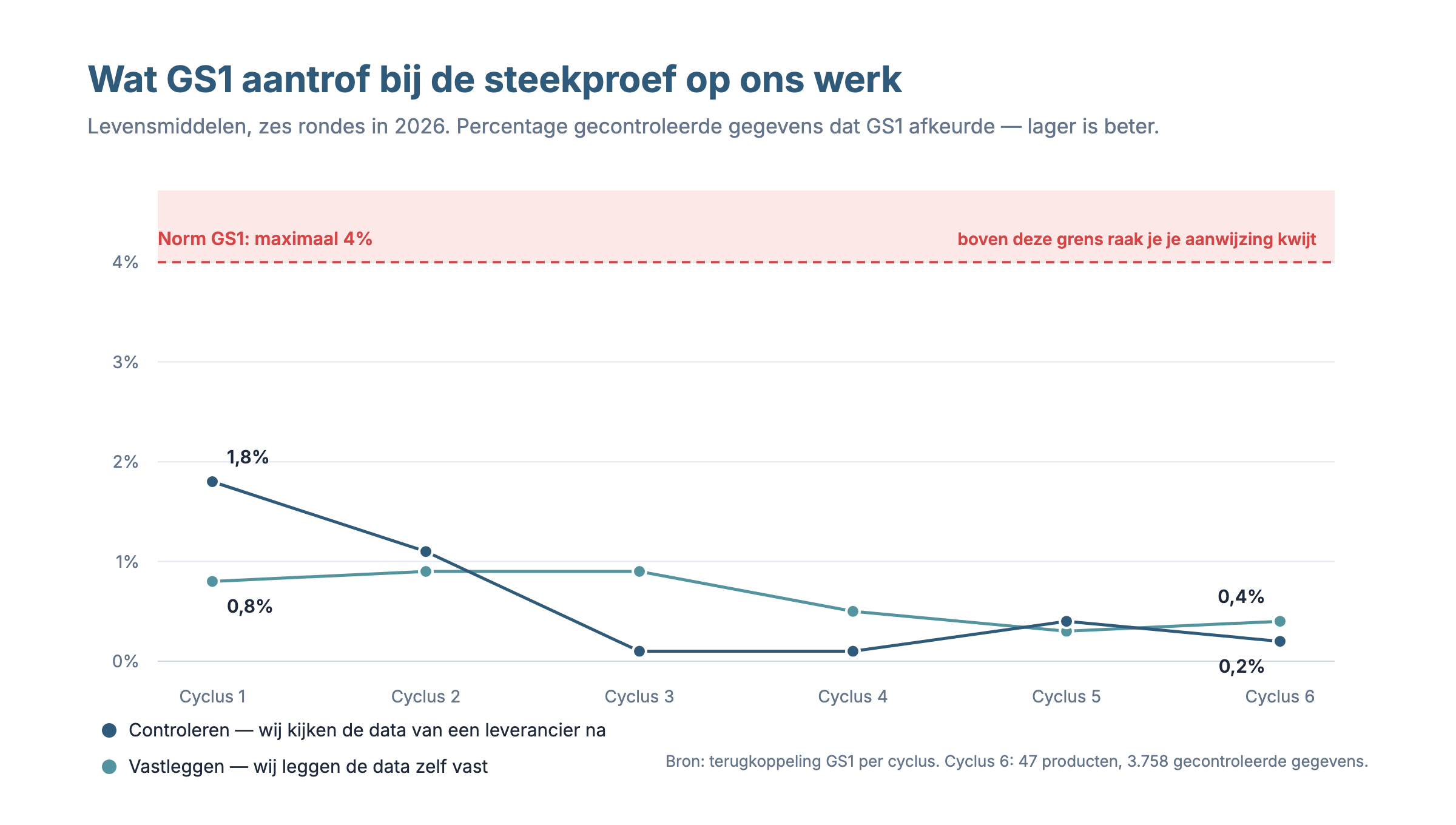
There is a strict upper limit: no more than 4% of the data checked may contain discrepancies. The appointment is valid for twelve months. A company that exceeds that limit three times during this period can lose its appointment — and may then be prohibited from carrying out any work in that category for six months.
A council that includes Albert Heijn, Superunie, PepsiCo, Unilever and Nestlé, among others, advises on such withdrawals. In other words, some of the country's largest buyers have visibility into how their data service providers perform. That says something about how seriously this is taken.
Why this matters to you
Most suppliers think about quality when choosing a product data partner. Understandably so. But there is a more fundamental question underneath it: what happens to your product flow if that company fails?
That risk is not mentioned in any contract. It is not in a quotation, and it does not come up during an introductory meeting. But it is real, and it is measurable — because there is an actual score.
So ask the question. Ask whoever you work with now, and ask us: how did you score in the latest GS1 sample check, and can I see the results? It is a reasonable question. If a company becomes uncomfortable when you ask, you already have your answer.
And if you are the person who has to justify this choice internally — to management, procurement or quality — that score is probably one of the most useful things you can have in your hands. It does not come from your supplier. It comes from GS1.
Our answer to that question
We believe you should be able to ask, so here is our answer upfront. These figures relate to the sample checks for food products; we are also appointed for categories including drugstore products, pet food and batteries, which are assessed separately.
So far, there have been six rounds in 2026. Across those rounds, GS1 approved an average of 99.4% of the data points checked. The standard is 96%.
Here are the figures from the latest round, because a percentage without context does not tell you much. GS1 selected 47 products and reviewed 3,758 individual data points: ingredients, allergens, nutritional values, packaging information, preparation instructions and contact details.
Of those, 3,747 were approved: 99.7%. Eleven data points were rejected, while the standard allows for 150.
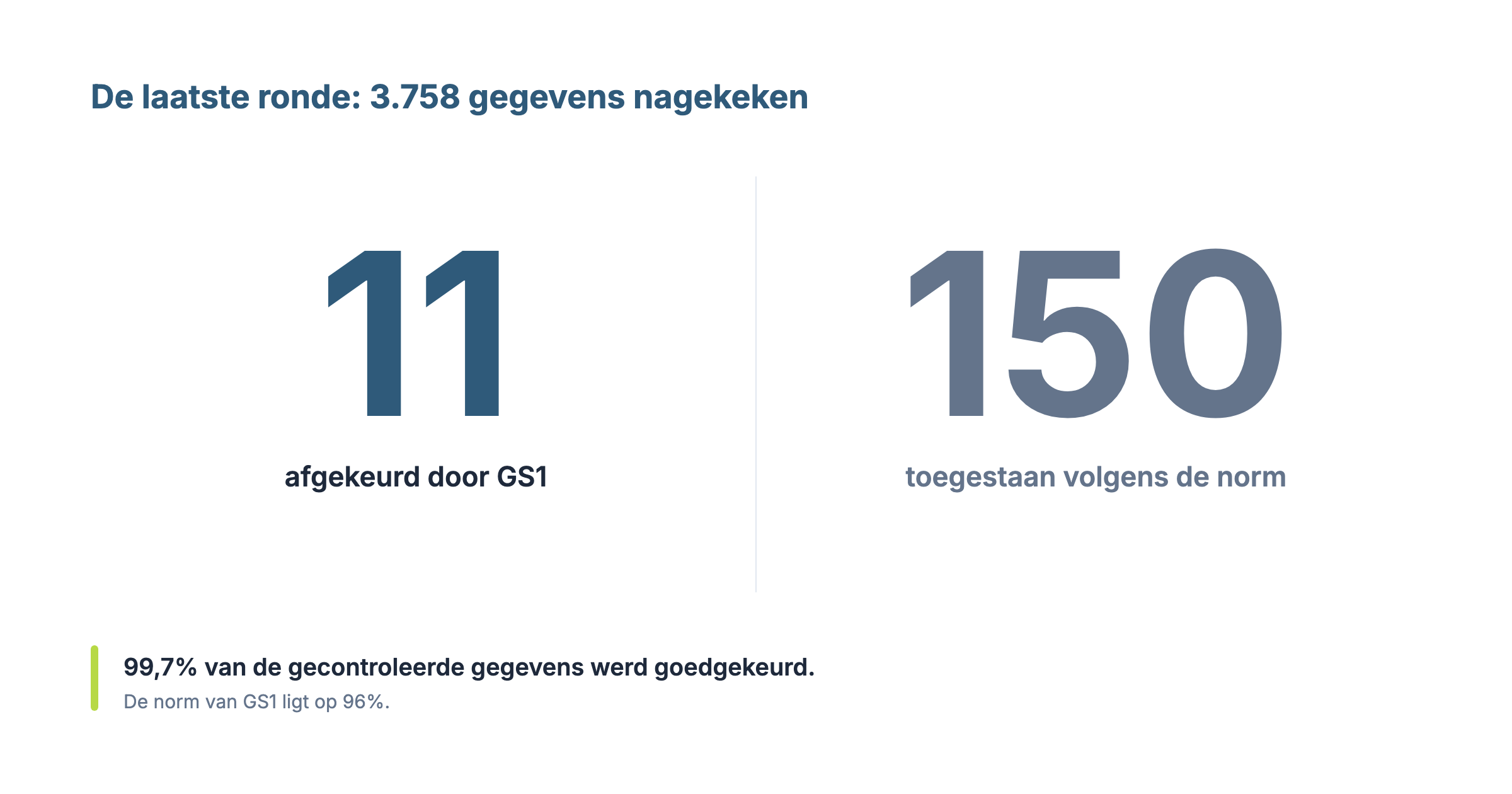
And yes, mistakes happen. Eleven of them in this case. An address written in capital letters where standard lettering was required. A type of packaging that should have been classified differently. We challenge findings when we disagree with them, GS1 makes the final decision, and what you see above is the final assessment — including the cases where GS1 ruled against us.
More important than the number itself is the direction of travel. On the checking side, the discrepancy rate fell from 1.8% to 0.2% over six rounds — a reduction of almost ninety percent. That is not just one good month. That is what happens when someone reviews your work every month and you act on the findings.
Finally
To be fair, we do not think this is the most interesting part of our work. The most interesting part is that you barely notice it. You send us your products and labels, and everything else simply runs as it should. GS1's quarterly updates, changing retailer requirements, upcoming legislation — you do not have to do anything.
That is what it is all about: less hassle, less to worry about.
But if you ask someone to take all of that off your hands, they should be able to prove that they are getting it right. Not by saying so. By having it measured.
XXtract — On the shelf fast. Fully compliant. Always accurate.